At least, that's what Matthew Lasar at Arstechnica believes. Piracy is no doubt an issue. Illegal downloading is wrong, and it hurts all artists that are targets from having their content stolen without being paid. In this article, Matthew says, "According to BLS [Bureau of Labor Statistics] data from the Federal government, the number of people who self describe themselves as musicians has declined since 1999 by 41 percent. Obviously piracy is not just a problem for our economy, but for our culture too." He goes on to say that less musicians are being paid for their work and it is piracy that is causing this harm to the arts. Lasar includes a chart to show how musicians have decreased over time.
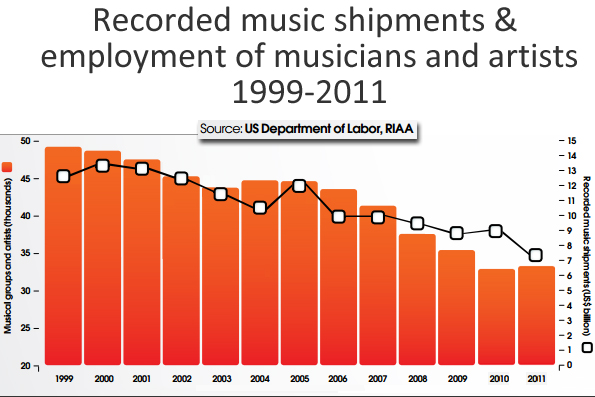
Lasar explains the chart saying, "If you look at the Digital Music News version of the chart, it looks like the orange bar over 1999 comes to about 49,000 "musicians & artists." The orange bar over 2011 comes to around 34,000 or so." This does come off as sounding pretty negative. Within 13 years, approximately 15,000 musicians have been lost because piracy is keeping them from making a profit.
We can only assume this chart is accurate, but I personally would disagree with this whole article. I don't believe that piracy has ultimately put a damper on the income of musicians and artists, and rather than losing these artists over the years, I think we're gaining them. As last week's reading stated, "The war against file-sharing is essentially a war against the distribution of uncopyrighted metadata, not against the distribution of copyrighted material." Music is under copyrighted material. There will always be people who try to download it for free, but there will also always be people who support the arts and are willing to pay for what they listen to or watch. Because of the Internet, thousands of people have been able to get themselves out in the world and known as musicians. Because of sites like YouTube or Bandcamp where people can find new music and listen to them for free, unknown artists are able to be recognized and flourish as a musician. They can grow as an artist and as more people find them, more people will be willing to pay to listen to more of their music. YouTube allows anyone who can put up original content to be considered musicians. One key person who proudly considers himself a musician who started through YouTube is Alex Day. He became famous through the Internet and his music has become popular. People can listen to his music for free. They're even encouraged to take his music and make their own renditions with it on some occasions. But even through all this, he has had his name make it to the top charts in UK on iTunes. To me, Alex Day is a prime example of a musician who does get paid for his music even in the times of piracy and downloading without paying. Piracy is a bad thing, and it can cause trouble, but to say it is completely wiping out musicians and destroying our economy and culture may be a bit of a stretch.

No comments:
Post a Comment