Monday, October 29, 2012

What I Did For Love

Kiss my privacy goodbye and point me toward Google. I did what I had to do to get the best results on the Internet. Siva Vaidhyanathan's book, The Googlization of Everything, talks about how we give our privacy away to Google without necessarily realizing it. Google offers many free services like Gmail, Blogger, and YouTube, catching us off guard."In return, Google gets information about our habits and predilections so that it can more efficiently target advertisements at us...It stores 'cookies' in our web-browsers to track our clicks and our curiosities." This means that our privacy really isn't safe and can even be sold to outside third parties, sometimes even without our knowledge or consent. We're sucked in to believe that everything is great and we have all this free access to websites and we can search Google all we want no strings attached but that really isn't true at all.
This is a screen cap of YouTube's suggestion page for my channel and own personal viewing. This could not exist if Google did not store my history of video searches and videos I've watched. It takes all my history an viewing information and puts together a page of videos it thinks I'd enjoy watching and as it happens, I would watch all the videos listed in this screen cap. Although it's a little discomforting to think that Google has the ability to take my information and use it however it pleases, I wouldn't be able to find so many videos that interest me without Google taking the information of what I have watched.

The truth is, it's a sacrifice we have to make to get what we want out of the Internet. If Google didn't track our history and information, we'd never deal with ads that served any interest to us and finding videos that were appealing to us would be much more difficult. And what many people may not know, Google searches would be much less reliable. Returning to Vaidhyanathan's book, he writes "If you do not allow Google to track your moves, you get less precise results to queries that would lead you to local restaurants and shops or sites catering to your interests." There is an option to change privacy settings on Google so that it won't track your history and cookies are disabled, but then results are very unstable and Google would fail to deliver web results that would normally be relevant to the intention of the user. And besides, even if we did keep our privacy settings strictly private, other public services like telephones and doctors would have that information and they would be giving that information out anyway, so in my opinion, why not let one more website take your information to give you the best results possible?

Saturday, October 13, 2012

The Privacy Invasion

In Rockwell's hit Somebody's Watching Me, one of his lines is "I always feel like somebody's watching me and I have no privacy." In this day and age these lyrics couldn't be truer. David Brin writes about the possibility of two different types of cities. One city is a myriad of cameras that "report their urban scenes straight to Police Central where security officers use sophisticated image processors to scan for infractions against an established way of thought." At first glance, this doesn't sound so bad. In fact, it sounds nice to know that the police will be able to do their job extremely well and crime rates could drop significantly. But then it sets in. How long till they start to misuse the information they have? One day they'll be using the cameras to help fight crime and the next day they're using it to spy on friends or enemies of theirs and getting a hold of personal information. Garfinkel mentions that our personal information is already being given out to third parties and that credit cards with private information can be viewed by officials to track where they've been and what they've been doing, which can be useful when solving a crime, but there is a very fine line between using that information for good and having it at your own disposal.

Jeffrey Rosen - Is Privacy Dead?


In this video, Jeffrey Rosen is talking about how privacy, to an extent is dying; how it no longer exists. All personal bubbles are being broken into and invaded. He mentions how things have changed severely since the 9/11 terrorist attacks. Phone calls and emails could be hacked into in order to find out if there was any relation to the attacks. Security has become a lot stricter wherever we go, airports being a prime example. It used to be a simple luggage scan to make sure there were no weapons and a metal detector to make sure nothing out of the ordinary was on you. But after 9/11 that all changed. There really is no sense of privacy in the airport now, Bags can be personally checked to make sure of nothing illegal, and rather than a simple metal detector, Rosen reveals how airports now have x-ray technology that can get a view of the person's actual naked body through clothing. This is repulsive in general and especially in the cases of underage children and disrespect to the elders. Also, many people have morals. The last thing they want strangers having is naked pictures of them. Privacy has no existence anymore in an airport. Again, they claim it is for our own good and safety, but when ordinary people have easy access to things like that, it no longer serves the purpose it was intended for.

Brin recognizes this problem and opens up to the idea of the second city. The second city is similar in the aspect that there are still cameras perched on every vantage point. However, "These devices do not report to the secret police. Rather, each and every citizen of this metropolis can use his or her own wristwatch television to call up images from any camera in town." Again, this sounds like a great concept. A person walking at night can check to make sure no one is lurking around the corner. Likewise a parent can check to see where there child may have run off to if they were missing. Even better, a shoplifter at a mall can be spotted and taken into custody in no time. And if that's not enough, as far as police headquarters goes, "any citizen may tune in on bookings...especially the camera control room itself, making sure that the agents on duty look out for violent crime, and only crime." This sounds great! We can even make sure the police don't abuse this power, but of course at some point the citizens will use it for their own personal desires such as to stalk someone they know, or to spy right in someone's backyard and just as easily upgrade to drones that they could steer right into the "privacy" of someone's home and record all of their passwords and other personal information. No matter which approach is taken, privacy is invaded. The invasion may claim to be for the good of the people, but in reality it may really be used for one's own shameful use. As this technology evolves even more and the idea of all citizens or anyone at all having access to seeing your every move and all your personal information, Rockwell's song about being paranoid that someone is always watching may not be a huge stretch from the truth.

Sunday, October 7, 2012

The Truth and Lies of Piracy

The digital age is here. The time it takes to download something off the Internet can take a mere matter of seconds. It's a wondrous thing, but it can be a serious problem for content creators who rely on their work to make money. Things like books and music are all going digital. They're becoming available online and to download, but this is where things get complicated. iTunes does a good job at making sure that artists' music is paid for before downloading and same for downloading e-books. But last week's reading of piracy talked about illegal downloading and copyrights. There are plenty of sites that require us to pay for the content we download, but there are numerous sites where one can download this content illegally without having to pay for any of it. There are also sites like YouTube where this content can be uploaded and viewed for free without ever paying. From there, people can take content and share it with others and redistribute. Soon enough no one is paying for anything and creators are losing money. Unfortunately, "Burning cd’s or gmailing files or giving them away with services like Yousendit.com, means quite much that piracy is stuck in the same infrastructure that it had during the era of the cassette tape and the photocopier, only multiplied by digital effectivity."

At least, that's what Matthew Lasar at Arstechnica believes. Piracy is no doubt an issue. Illegal downloading is wrong, and it hurts all artists that are targets from having their content stolen without being paid. In this article, Matthew says, "According to BLS [Bureau of Labor Statistics] data from the Federal government, the number of people who self describe themselves as musicians has declined since 1999 by 41 percent. Obviously piracy is not just a problem for our economy, but for our culture too." He goes on to say that less musicians are being paid for their work and it is piracy that is causing this harm to the arts. Lasar includes a chart to show how musicians have decreased over time.
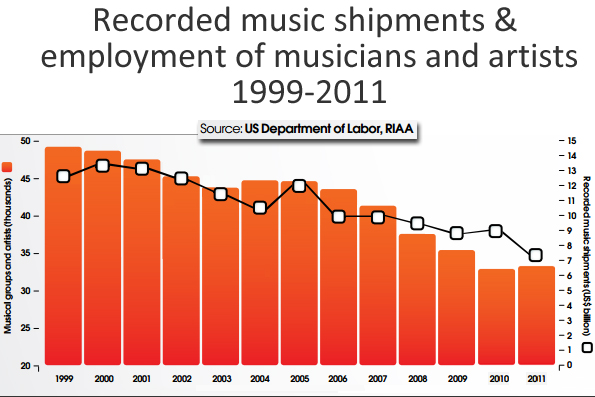
Lasar explains the chart saying, "If you look at the Digital Music News version of the chart, it looks like the orange bar over 1999 comes to about 49,000 "musicians & artists." The orange bar over 2011 comes to around 34,000 or so." This does come off as sounding pretty negative. Within 13 years, approximately 15,000 musicians have been lost because piracy is keeping them from making a profit.

We can only assume this chart is accurate, but I personally would disagree with this whole article. I don't believe that piracy has ultimately put a damper on the income of musicians and artists, and rather than losing these artists over the years, I think we're gaining them. As last week's reading stated, "The war against file-sharing is essentially a war against the distribution of uncopyrighted metadata, not against the distribution of copyrighted material." Music is under copyrighted material. There will always be people who try to download it for free, but there will also always be people who support the arts and are willing to pay for what they listen to or watch. Because of the Internet, thousands of people have been able to get themselves out in the world and known as musicians. Because of sites like YouTube or Bandcamp where people can find new music and listen to them for free, unknown artists are able to be recognized and flourish as a musician. They can grow as an artist and as more people find them, more people will be willing to pay to listen to more of their music. YouTube allows anyone who can put up original content to be considered musicians. One key person who proudly considers himself a musician who started through YouTube is Alex Day. He became famous through the Internet and his music has become popular. People can listen to his music for free. They're even encouraged to take his music and make their own renditions with it on some occasions. But even through all this, he has had his name make it to the top charts in UK on iTunes. To me, Alex Day is a prime example of a musician who does get paid for his music even in the times of piracy and downloading without paying. Piracy is a bad thing, and it can cause trouble, but to say it is completely wiping out musicians and destroying our economy and culture may be a bit of a stretch.