Sunday, November 4, 2012

Drama: A Real Life Tragedy

The theme of this week's readings had to do with cyber bullying. One article we read talked about how a case of cyber bullying led to the suicide of a 13 year old girl. Megan Meier got a message from an alleged 16 year old boy who seemed to show interest in her. They exchanged messages and she formed feelings for him. One day out of the blue she started receiving messages from her saying he didn't want to be friends anymore and she was better off dead. She took that advice and hung herself a day later. According to reports, it turns out that "The mother of a former friend of Megan's allegedly created a fictitious profile in order to gain Megan's trust and learn what Megan was saying about her daughter. But the communication eventually turned hostile." Because a mother was too involved in her own child's life, she caused the death of another mother's child; all because of her cyber bullying. And as Ron Meier said, "That's the biggest tragedy of this whole thing: An adult did it." It couldn't be more true. Kids don't always know what they're getting into. Kids don't always realize they are involved in cyber bullying, but the fact that it was a mother that caused this is horrendous.

                Girls and Their Drama


I once made a video about girls and their drama. To sum up this video, I used to sit with some friends during lunch and all they talked about was the drama in their lives. Always about another girl and how much they disliked these other people. Some days I would listen and think to myself, "Wow, you know, some of the things these girls are saying is kind of serious. I hope they realize that." Now although my video does not cover cyber bullying very much, it transitions into the idea that cyber bullying does not always have to come from a complete stranger on the Internet. In fact, more often than not, cyber bullying occurs between peers. Sometimes it is harder for people to bully in person, so they hide behind a screen to do their dirty work. Or bullies carry on their playtime on the Internet so that the "drama" doesn't just exist in school. And although, none of the drama I have overheard resulted in suicide, there has been fights before and without giving details, the drama has continued over to social websites like Facebook so that the bullying in person became cyber bullying.

The article continues to explain this. It reads "In the information age, playground poundings have moved to online chat rooms and instant messages. Nearly half of all teenagers report they have been the victim of cyber attacks. Everything from text messaging to e-mail can be used to bully victims. Some people even create Web sites solely dedicated to harassment." Sadly, one negative effect of the internet is that bullying can now move from in person to a computer at home. There is no escape from bullying now. If it's not happening at school or a public place, it's happening over a social network or through text messages. The problem is, the targets are getting younger and younger and so they are not at an emotionally stable level to handle the cyber attacks. Nancy Willard says, "When emotionally vulnerable young people get online, they can be very easily manipulated." This is why all the negative remarks calling Megan Meier fat and ugly led to her suicide. She was vulnerable and caught off guard and didn't know why all these things were being said about her. She couldn't handle the cyber bullying and so she ended her life. People think just because they say something behind a computer screen mean nothing could ever happen but the reality is that what happens on the Internet can lead to actions in real life and they can result in suicide, a true tragedy.

Monday, October 29, 2012

What I Did For Love

Kiss my privacy goodbye and point me toward Google. I did what I had to do to get the best results on the Internet. Siva Vaidhyanathan's book, The Googlization of Everything, talks about how we give our privacy away to Google without necessarily realizing it. Google offers many free services like Gmail, Blogger, and YouTube, catching us off guard."In return, Google gets information about our habits and predilections so that it can more efficiently target advertisements at us...It stores 'cookies' in our web-browsers to track our clicks and our curiosities." This means that our privacy really isn't safe and can even be sold to outside third parties, sometimes even without our knowledge or consent. We're sucked in to believe that everything is great and we have all this free access to websites and we can search Google all we want no strings attached but that really isn't true at all.
This is a screen cap of YouTube's suggestion page for my channel and own personal viewing. This could not exist if Google did not store my history of video searches and videos I've watched. It takes all my history an viewing information and puts together a page of videos it thinks I'd enjoy watching and as it happens, I would watch all the videos listed in this screen cap. Although it's a little discomforting to think that Google has the ability to take my information and use it however it pleases, I wouldn't be able to find so many videos that interest me without Google taking the information of what I have watched.

The truth is, it's a sacrifice we have to make to get what we want out of the Internet. If Google didn't track our history and information, we'd never deal with ads that served any interest to us and finding videos that were appealing to us would be much more difficult. And what many people may not know, Google searches would be much less reliable. Returning to Vaidhyanathan's book, he writes "If you do not allow Google to track your moves, you get less precise results to queries that would lead you to local restaurants and shops or sites catering to your interests." There is an option to change privacy settings on Google so that it won't track your history and cookies are disabled, but then results are very unstable and Google would fail to deliver web results that would normally be relevant to the intention of the user. And besides, even if we did keep our privacy settings strictly private, other public services like telephones and doctors would have that information and they would be giving that information out anyway, so in my opinion, why not let one more website take your information to give you the best results possible?

Saturday, October 13, 2012

The Privacy Invasion

In Rockwell's hit Somebody's Watching Me, one of his lines is "I always feel like somebody's watching me and I have no privacy." In this day and age these lyrics couldn't be truer. David Brin writes about the possibility of two different types of cities. One city is a myriad of cameras that "report their urban scenes straight to Police Central where security officers use sophisticated image processors to scan for infractions against an established way of thought." At first glance, this doesn't sound so bad. In fact, it sounds nice to know that the police will be able to do their job extremely well and crime rates could drop significantly. But then it sets in. How long till they start to misuse the information they have? One day they'll be using the cameras to help fight crime and the next day they're using it to spy on friends or enemies of theirs and getting a hold of personal information. Garfinkel mentions that our personal information is already being given out to third parties and that credit cards with private information can be viewed by officials to track where they've been and what they've been doing, which can be useful when solving a crime, but there is a very fine line between using that information for good and having it at your own disposal.

Jeffrey Rosen - Is Privacy Dead?


In this video, Jeffrey Rosen is talking about how privacy, to an extent is dying; how it no longer exists. All personal bubbles are being broken into and invaded. He mentions how things have changed severely since the 9/11 terrorist attacks. Phone calls and emails could be hacked into in order to find out if there was any relation to the attacks. Security has become a lot stricter wherever we go, airports being a prime example. It used to be a simple luggage scan to make sure there were no weapons and a metal detector to make sure nothing out of the ordinary was on you. But after 9/11 that all changed. There really is no sense of privacy in the airport now, Bags can be personally checked to make sure of nothing illegal, and rather than a simple metal detector, Rosen reveals how airports now have x-ray technology that can get a view of the person's actual naked body through clothing. This is repulsive in general and especially in the cases of underage children and disrespect to the elders. Also, many people have morals. The last thing they want strangers having is naked pictures of them. Privacy has no existence anymore in an airport. Again, they claim it is for our own good and safety, but when ordinary people have easy access to things like that, it no longer serves the purpose it was intended for.

Brin recognizes this problem and opens up to the idea of the second city. The second city is similar in the aspect that there are still cameras perched on every vantage point. However, "These devices do not report to the secret police. Rather, each and every citizen of this metropolis can use his or her own wristwatch television to call up images from any camera in town." Again, this sounds like a great concept. A person walking at night can check to make sure no one is lurking around the corner. Likewise a parent can check to see where there child may have run off to if they were missing. Even better, a shoplifter at a mall can be spotted and taken into custody in no time. And if that's not enough, as far as police headquarters goes, "any citizen may tune in on bookings...especially the camera control room itself, making sure that the agents on duty look out for violent crime, and only crime." This sounds great! We can even make sure the police don't abuse this power, but of course at some point the citizens will use it for their own personal desires such as to stalk someone they know, or to spy right in someone's backyard and just as easily upgrade to drones that they could steer right into the "privacy" of someone's home and record all of their passwords and other personal information. No matter which approach is taken, privacy is invaded. The invasion may claim to be for the good of the people, but in reality it may really be used for one's own shameful use. As this technology evolves even more and the idea of all citizens or anyone at all having access to seeing your every move and all your personal information, Rockwell's song about being paranoid that someone is always watching may not be a huge stretch from the truth.

Sunday, October 7, 2012

The Truth and Lies of Piracy

The digital age is here. The time it takes to download something off the Internet can take a mere matter of seconds. It's a wondrous thing, but it can be a serious problem for content creators who rely on their work to make money. Things like books and music are all going digital. They're becoming available online and to download, but this is where things get complicated. iTunes does a good job at making sure that artists' music is paid for before downloading and same for downloading e-books. But last week's reading of piracy talked about illegal downloading and copyrights. There are plenty of sites that require us to pay for the content we download, but there are numerous sites where one can download this content illegally without having to pay for any of it. There are also sites like YouTube where this content can be uploaded and viewed for free without ever paying. From there, people can take content and share it with others and redistribute. Soon enough no one is paying for anything and creators are losing money. Unfortunately, "Burning cd’s or gmailing files or giving them away with services like Yousendit.com, means quite much that piracy is stuck in the same infrastructure that it had during the era of the cassette tape and the photocopier, only multiplied by digital effectivity."

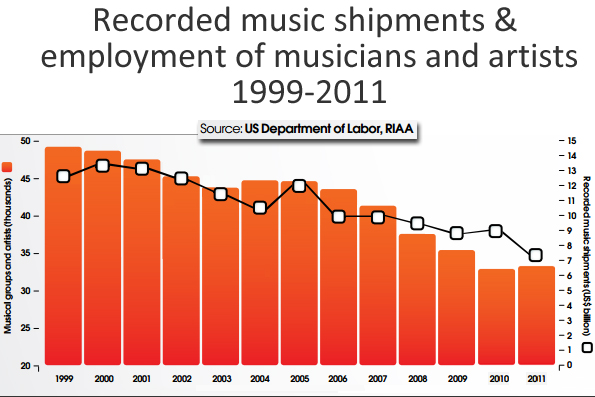
At least, that's what Matthew Lasar at Arstechnica believes. Piracy is no doubt an issue. Illegal downloading is wrong, and it hurts all artists that are targets from having their content stolen without being paid. In this article, Matthew says, "According to BLS [Bureau of Labor Statistics] data from the Federal government, the number of people who self describe themselves as musicians has declined since 1999 by 41 percent. Obviously piracy is not just a problem for our economy, but for our culture too." He goes on to say that less musicians are being paid for their work and it is piracy that is causing this harm to the arts. Lasar includes a chart to show how musicians have decreased over time.
Lasar explains the chart saying, "If you look at the Digital Music News version of the chart, it looks like the orange bar over 1999 comes to about 49,000 "musicians & artists." The orange bar over 2011 comes to around 34,000 or so." This does come off as sounding pretty negative. Within 13 years, approximately 15,000 musicians have been lost because piracy is keeping them from making a profit.

We can only assume this chart is accurate, but I personally would disagree with this whole article. I don't believe that piracy has ultimately put a damper on the income of musicians and artists, and rather than losing these artists over the years, I think we're gaining them. As last week's reading stated, "The war against file-sharing is essentially a war against the distribution of uncopyrighted metadata, not against the distribution of copyrighted material." Music is under copyrighted material. There will always be people who try to download it for free, but there will also always be people who support the arts and are willing to pay for what they listen to or watch. Because of the Internet, thousands of people have been able to get themselves out in the world and known as musicians. Because of sites like YouTube or Bandcamp where people can find new music and listen to them for free, unknown artists are able to be recognized and flourish as a musician. They can grow as an artist and as more people find them, more people will be willing to pay to listen to more of their music. YouTube allows anyone who can put up original content to be considered musicians. One key person who proudly considers himself a musician who started through YouTube is Alex Day. He became famous through the Internet and his music has become popular. People can listen to his music for free. They're even encouraged to take his music and make their own renditions with it on some occasions. But even through all this, he has had his name make it to the top charts in UK on iTunes. To me, Alex Day is a prime example of a musician who does get paid for his music even in the times of piracy and downloading without paying. Piracy is a bad thing, and it can cause trouble, but to say it is completely wiping out musicians and destroying our economy and culture may be a bit of a stretch.

Sunday, September 30, 2012

The Era of the Vlogger

In this past week's readings, we read an article about the entrepreneurial Vlogger by Jean Burgess and Joshua Green. In this article, they talk about YouTube and how the vlogger, or video-blogger, has shaped the YouTube community. According to the article, "vlogs make up almost half of the top thirty Most Subscribed channels on YouTube." To the people who don't quite understand what a vlogger does, basically they create videos that are "typically structured primarily around a monologue delivered directly to the camera, vlogs are characteristically produced with little more than a webcam and some witty editing." So how can someone doing something so simplistic become some of the most popular people on YouTube and even the whole Internet? Unlike videos uploaded by big networks or other professional companies and people, vloggers are a lot more direct and personal with their viewers. Like the article says, "More than any other form in the sample, the vlog as a genre of communication invites critique, debate and discussion. Direct response, through comment and via video, is central to this mode of discussion." Vloggers are able to be entrepreneurial because they put out their content and stay very active within the community.

When I think of vloggers, one big name comes to mind: the British twenty-some year old vlogger, Charlie McDonnell. This article talks about how "Charlie McDonnell has become an international star with his web channel charlieissocoollike by becoming the first British person to generate a million regular viewers on YouTube." I started watching his videos back in 2010 and he fully deserves the views and fans. The beautiful thing about a successive vlogger is that it is their own content and work that has gotten them to where they are in life. Charlie has worked on multiple collaborative projects with other people like producing three albums, two of which are with some of his friends about Doctor Who and all three can be found on iTunes, but he creates all of his videos. No one else is scripting what he says or does. It's purely him talking to a camera in his room or wherever he may be. Just like in Burgess and Green's article, Charlie McDonnell is also very keen on being direct and personal in his videos. He says, “When people watch YouTube videos, they're usually just one person sitting in front of their computer, and so with that in mind, I try to make my videos more personal, like I'm speaking to one person rather than a big audience." Charlie has not only succeeded as far as a fan base goes, he's also made money from YouTube. Often a viewer will hear him say how making videos is his job and he doesn't need to work anywhere else. Because of his earnings, he has been able to skip university and start his media career in London where he also purchased his first house all paid for from the money made from YouTube.

Charlie McDonnell has been a huge inspiration to me as I have started up my own vlogs. He was just a normal teenager and now he's a celebrity and making money by doing what he loves. Going back to the first article, it says "that amateur and entrepreneurial uses of YouTube are not separate, but coexisting and coevolving." This is completely true. People often start on YouTube as amateurs, but as they improve and their viewership increases, they become more involved with the community. If they're lucky enough, they may even get paid for the videos they produce and many vloggers from that point create better content and sometimes like to give back to their viewers. They appreciate your subscribers and often ask for requests and ideas to please the audience. Vloggers run the YouTube community for a very good reason. They have imagination that only they can have and we live in a time where original content is preferred. So many times TV shows and movies are knock-offs or remakes, but vlogs are full of completely original works.

Sunday, September 23, 2012

"I Live on the Net."

One section of last week's reading of Fred Turner's From Counterculture to Cyberculture talked about how we live on the Internet. Our generation of people are getting busier and we are all over the place. Some people are constantly moving from place to place never really having a solid address. Esther Dyson's quote, "I live on the Net," is so true. Like many of us today, "It's the medium I use to communicate with many of my friends and colleagues." The Internet has become the one place where people can be contacted no matter where they are.

I myself connect with this statement. For one thing, I'm in college now. I no longer live at home. My address is no longer what it was three weeks ago. Now it's something new. And it will be my address for a time, but then break will roll around and I'll once again be back home and my address will change once more. And this process will repeat over the course of 4 years. And then the rest of my life will begin and my place of residence will change yet again. It would be quite difficult to give someone a long term address to use to send me mail. However, through all that time, there is one place that you will always be able to find me: the Internet. My email will not change. My usernames on social networks will not change. I will still be very much alive on the Internet. I will still be checking messages and emails coming in. For another thing, I've built up a large group of Internet friends and they've become a large part of my life over the last couple years. The problem is, they live all over the world. They all have different addresses. And every now and then they move. There's no way I could keep track of them all when I wanted to contact them. But I can rely on Twitter and Facebook to send mass messages to all of them if need be instead of writing individual letters to each one and I can connect with them and Skype and have real face to face chats even though they may live across the country. We live on the Internet. That's where we can find each other. And on occasion we may even meet in person, but for the rest of the time, that's how this generation can keep in touch.

John Perry Barlow sums it up perfectly. He says, "I live at Barlow@eff.org. That's where I live. That is my home. If you want to find me, that's the only place you're liable to be able to do it...there really is no way to track me." So often these days we're on the run, always going to different places getting involved in different things. "Home" tends to move around now and then and you can't always rely on a street address to find someone. But if you have an email address or someone's account on a social network such as Facebook, you have a much greater chance of getting a hold of them. Society is raising us to constantly check our emails, and send text messages to our friends. We have to keep up with the times if we want to keep in touch with our friends and family. Earth is a large place full with 7 billion people. They are scattered across 7 continents, but there is one place that they can all come together and live. That place is called the Internet.

Wednesday, September 12, 2012

Introduction to Digital Cultures

Just a simple update and I'm sure it won't be a big issue for those who do read my blog since I rarely post here anymore. From here on out, at least for the next 10 weeks or so, this blog will be dedicated to blog post assignments for my class Intro to Digital Cultures. I suspect whatever I am to write on should be relatively interesting so keep checking 'em out when they show up.

DFTBA

Sunday, June 17, 2012

A 54 Word Short Story

The Princess


          “I love you,” the princess thought looking down at the green grass, but rather said, “Hi.”

          “Hello. How’re you?"

          “I’m good, thank you.” He smiled as their eyes met in silence.
          “Well, I better get going.”
          “Right. Goodbye,” She said. “He noticed me,” she thought. She wasn’t really a princess. Just in his eyes.